The YOC is currently holding rolling auditions for all ensembles for the 26-27 season. Acceptance and placement is a competitive, merit-based process. Musicians must meet specified requirements, outlined below, for consideration.
To apply for the 26-27 season, please submit a Rolling Audition Registration form along with the non-refundable $35 audition fee. Following your form submission, we will reach out with requirements for a video audition. After all audition materials have been reviewed, you will receive audition results via email.
There is no sight reading required for rolling auditions.
Audition tips 🎻
- Scales
- If scales are a part of your audition, prepare all scales at a tempo you can play cleanly with good intonation and tone quality. If scales are either 2 or 3 octaves, know that 3 octaves are preferred, but it would be better to play 2 octaves well than 3 octaves poorly. Practice scales in different orders. You will most likely not play all your scales at the audition.
- Solo or Required Pieces
- Prepare the solo to the best of your ability. We are listening for rhythmic accuracy, pitch, tone quality, and musical expression. In a live audition, it is possible that you will not play all of your solo(s) due to time constraints. For required solos, please prepare the entire piece. For solos of your choice, you can expect to play no more than 3-4 minutes.
- Excerpts
- Prepare the required excerpt(s) as accurately as possible. Work with a metronome to ensure that your tempos are steady. If you have a private instructor or band/orchestra teacher, then it is a great idea to ask them for advice.
- Sightreading
- Practice sightreading small excerpts of music. Look at the key, time signatures, and tempo indication. “Hear” the music in your head with consideration to these details. You will have about 30 seconds to look at the excerpt before playing it in the audition.
- Mock Audition
- Practice taking an audition by playing a required scale, your solo, the excerpts, and some sightreading. This will help you get comfortable with the pace of the audition. It can be helpful to practice a mock audition in front of others (family, teachers, etc.) to help with nerves.
- Live Auditions
- If you are doing a live audition, please arrive 15-20 minutes early. You will be given a practice room to warm up and play through your excerpts. We recommend playing through your excerpts slowly as a warm up.
- We are here for you!
- Remember – we are excited to hear you play! We are looking for hard work, a good ear, and overall musicality, not perfection. Take a deep breath and remember that the judges are looking forward to hearing you. It can also help to remember that all of our judges have been on the other side of the audition process. You’ve got this!
Youth Orchestra
As our most advanced ensemble, the Youth Orchestra is a full symphony orchestra made up of experienced young musicians. They perform staples of orchestral repertoire in a professional symphony setting.
Rehearsals: Mondays from 5:45-8:15pm at St. Luke’s Lutheran Church (August-May)
Strings
In addition to the requirements listed, all musicians will be asked to do sightreading as part of their audition.
Violin
- Solo: Prepare a solo of your choice that best demonstrates your ability; level of at least a Beethoven Romance or Mozart Concerto.
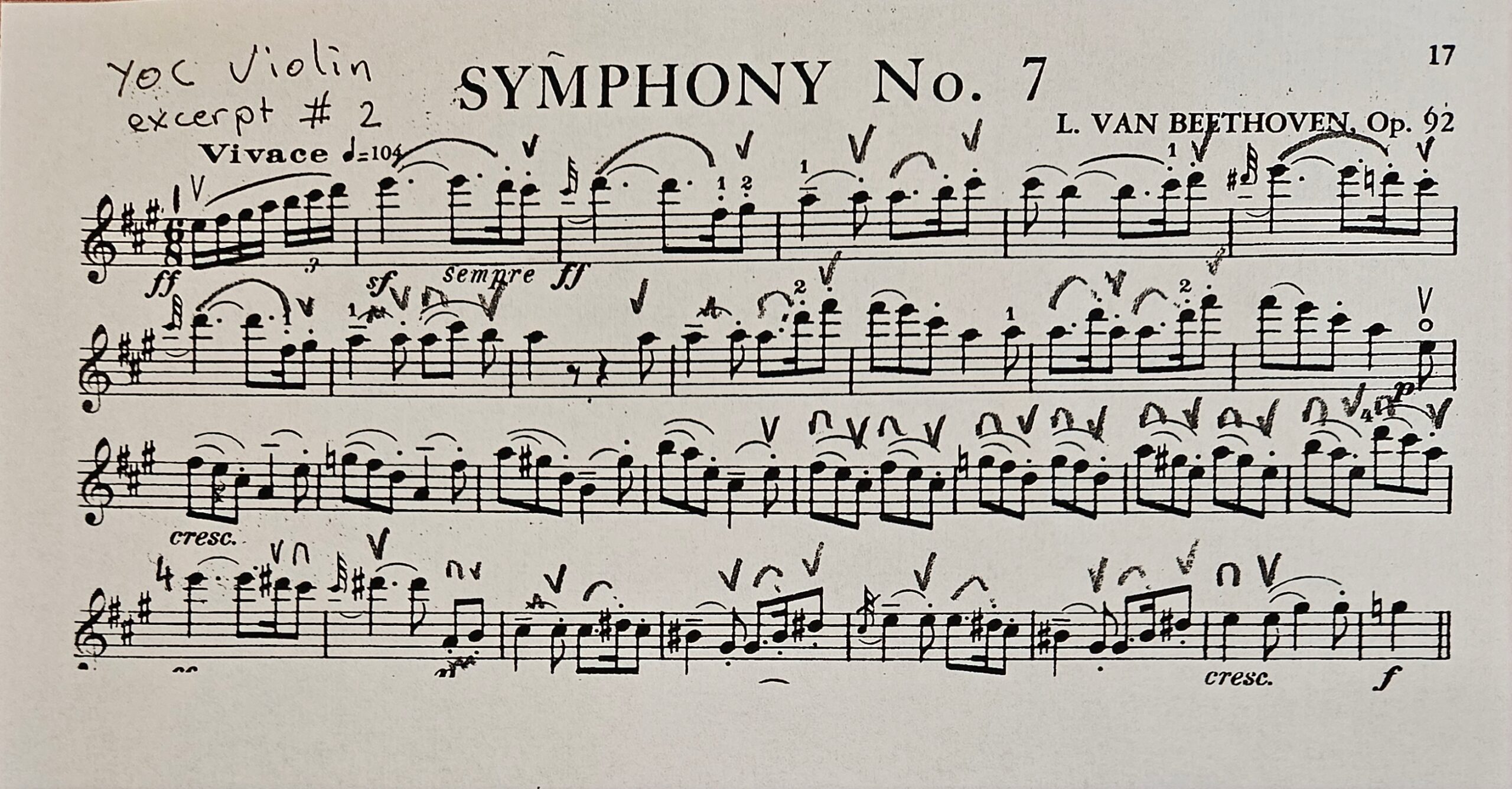
- Excerpts
Viola
- Solo: Hoffmeister Concerto in D, or two contrasting movements from Bach’s Cello Suites, or a piece that demonstrates your best ability.
- Excerpt
Cello
- Prepare a solo of your choice that best demonstrates your ability; should include elements of thumb position.
- Excerpts
Bass
- Solo: Prepare a solo of your choice that best demonstrates your ability; should be of a technical level similar to that required for Western Regional auditions such as J.S. Bach – Gavotte or Franz Simandl – Etude #17
- Excerpts
Woodwinds
In addition to the requirements listed, all musicians will be asked to do sightreading as part of their audition.
Flute + Piccolo
- Three octave chromatic scale from low C
- Solo: Bach Flute Sonata in E major BWV 1035
- Excerpts
Oboe + English Horn
- Chromatic scale from low C to high E-flat (three ledger lines above staff)
- Solo: Albinoni Oboe Concerto in D minor Op. 9, No. 2
- Excerpts
Clarinet + Bass Clarinet
- Chromatic scale from low E to high G (four ledger lines above staff)
- Solo: Weber Concertino for Clarinet
- Excerpts
Bassoon
- Three octave chromatic scale from low B-flat
- Solo: Telemann Bassoon Sonata in F minor, movements 1 & 2
- Excerpts
Brass
In addition to the requirements listed, all applicants will be asked to do sightreading as part of their audition. Prepare the below excerpts for your instrument.
Percussion/Harp
In addition to the requirements listed, all musicians will be asked to do sightreading as part of their audition.
Harp
- Solo: A solo of candidate’s choice demonstrating their ability on the harp.
- Excerpt:
- Harp Audition Excerpt – Waltz of the Flowers cadenza
Percussion
- Solo: 1 Snare AND 1 Timpani solo of your choice. You must bring copies of your solos for the judges.
- Scales: Ab and G major scales (2 octaves), C and G natural minor scales (2 octaves)
- In addition:
- a 30 second roll going from ppp – fff – ppp on snare drum and timpani
- tuning exercise on timpani (be prepared to tune pitches by ear – may use a tuning fork or pitch pipe)
Preparatory Orchestra
The Preparatory Orchestra is our training ensemble for the Youth Orchestra, a full symphony orchestra that performs both actual symphonic literature and arrangements of the repertoire geared to advanced younger players.
Rehearsals: Rehearsals: Saturdays from 2:00-4:00pm at St. Luke’s Lutheran Church (September-May)
Strings
In addition to the requirements listed, all musicians will be asked to do sightreading as part of their audition.
Violin
- Solo: A solo of the applicant’s choice demonstrating their ability on the instrument; difficulty level of at least Vivaldi a minor Concerto, 1st movement, or higher.
- Scales: D Major, a minor. (2 octaves required. 3 preferred)
- Excerpt: Violin Audition Excerpt
Viola
- Solo: A piece of your choice that best represents your ability; difficulty level of at least Suzuki books 3 or higher.
- Scales: C,D, and E flat major; C and D minor
- Excerpt: Viola Audition Excerpt
Cello
- Solo: A solo of the applicant’s choice demonstrating their ability on the instrument; similar in difficulty to Marcello Sonata in e minor, or at least Suzuki book 3 or higher.
- Scales: D major (2 octaves required, 3 preferred); G melodic minor scale (2 octaves)
- Excerpt: Cello Audition Excerpt
Bass
- Solo: A movement or section from a Vivaldi or Marcelo Sonata or a piece similar in difficulty to at least Suzuki book 2 or higher.
- Scales: E and G major 2 octaves
- Excerpt: Bass Audition Excerpt
Woodwinds
In addition to the requirements listed, all musicians will be asked to do sightreading as part of their audition.
- Solo: Prepare a solo of your choice that best demonstrates your ability
- Scales: D major and Chromatic
- Excerpt:
Brass
In addition to the requirements listed, all applicants will be asked to do sightreading as part of their audition. Prepare the below excerpts for your instrument.
- Solo: Prepare a short solo of your choice that best demonstrates your ability.
- Scales:
- French Horn – D (1 octave) F (2 octave), chromatic
- Trumpet – G (2 octave), F (1 octave), chromatic
- Trombone – G (1 octave), F (2 octave), chromatic
- Tuba – G (1 octave), F (2 octave), chromatic
- Excerpts:
Percussion/Harp
In addition to the requirements listed, all musicians will be asked to do sightreading as part of their audition.
Harp
- Solo: Prepare a solo of your choice that demonstrates your ability.
- Excerpt: Intermezzo from Bizet Carmen Suite No. 1 (beginning to downbeat of A)
Percussion
- Solo: Snare solo of your choice. You must bring a copy of your solo for the judges.
- Scales: A & Eb major (1 octave)
- In addition:
- Play a 30 second roll going from ppp – fff – ppp on snare drum and timpani, tuning exercise on timpani (be prepared to tune pitches by ear – may use a tuning fork or pitch pipe)
- Play the following fundamentals 6-8 times each at a moderate tempo
- 8th or 16th note paradiddles
- 6-8 closed 9 stroke and 5 stroke rolls
- 6-8 quarter note flams
Sinfonia Strings
Sinfonia Strings is our string ensemble that prepares young musicians in the art of orchestral performance.
Rehearsals: Saturdays from 11:45-1:45pm at St. Luke’s Lutheran Church (September-May)
Violin
In addition to the requirements listed, all applicants will be asked to do sightreading as part of their audition.
- Solo: A solo of candidate’s choice demonstrating their ability on the instrument; difficulty level of at least books 2-3 of Suzuki books, showing shifting into positions
- Scales: A and D Major 2 Octaves (slur 4, no arpeggios)
- Excerpt: Violin Audition Excerpt
Viola
In addition to the requirements listed, all applicants will be asked to do sightreading as part of their audition.
- Solo: solo of choice that demonstrates your ability on the instrument but a level of at least Suzuki 2-3.
- Scales: D and G major 2 Octave (slur 4, no arpeggios)
- Excerpt: Viola Audition Excerpt
Cello
In addition to the requirements listed, all applicants will be asked to do sightreading as part of their audition.
- Solo: solo of choice that demonstrates your ability on the instrument but a level of at least Suzuki 2-3
- Scales: D and G Major 2 Octaves (slur 4, no arpeggios)
- Excerpt: Cello Audition Excerpt
Bass
In addition to the requirements listed, all applicants will be asked to do sightreading as part of their audition.
- Solo: solo of choice that demonstrates your ability on the instrument but a level of at least Suzuki 2-3.
- Scales: D Major 1 octaves, G Major 1 Octave (slur 4, no arpeggios)
- Excerpt: Bass Audition Excerpt
Flute Choir
Our Flute Choir is an ensemble of experienced young musicians that performs flute choir repertoire and explores a wide variety of musical genres.
Rehearsals: Mondays from 4:15-5:45pm at St. Luke’s Lutheran Church (September – May)
Flute Choir requirements are the same as the requirements for Flute + Piccolo Youth Orchestra requirements
- Three octave chromatic scale from low C
- Solo: Bach Flute Sonata in E major BWV 1035
- Excerpt: Flute + Piccolo Audition Excerpts
Note
Auditions are not meant to stress you out! They are a necessary part of learning to become an accomplished musician. The judges want you to demonstrate what you can do. Prepare all of the requirements listed for your instrument/ensemble. The judges are listening for rhythmic accuracy, appropriate tempos, intonation, pitch accuracy, tone, musicality, and technical fluency